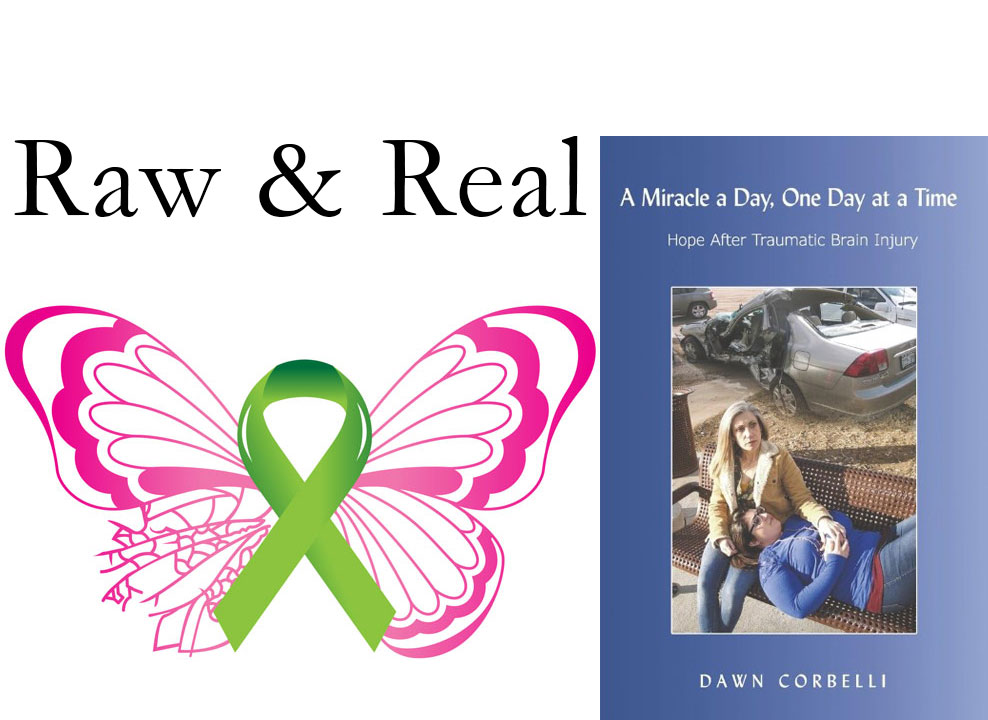
I must begin this week by telling you something wonderful happened to me a few days ago. Our, Veronica’s and my, neuropsychologist read my book titled,
A Miracle a Day, One Day at a Time: Hope After Traumatic Brain Injury
and said it would be an excellent book for patients, their families, and clinicians. I feel so shocked and grateful for his opinion!
To continue from last week’s blog, I want to define some words I did not know the meaning of in the beginning or even later in Veronica’s and my recovery from our brain injuries. Many I learned while doing research as I wrote my book many years later and I thought it might help others if I defined them, too.
The condition of adynamia applies to Veronica for many years following her injury, as it does for so many.
Adynamia-Following brain injury, it is related to difficulties with the ability to initiate or start activities and to the ability to keep going to finish an activity or task. I previously posted a blog about adynamia that goes into much more detail. I highly recommend reading it so you can understand your struggling survivor or yourself if you are the one injured. I read a detailed article I recommend, as well. It talks about not being able to carry out self-care, basic household tasks, and worst of all people often think the survivor is lazy when they are not. Resource: ABIOS Acquired Brain Injury Outreach Service. Understanding Adynamia and Lack of Motivation After Brain injury Reviewed by Andrea Reikensmeyer Updated March 21, 2022. This article gives causes, signs and symptoms, and how to try to overcome.
Aphasia– A language disorder caused by damage in a specific area of the brain that controls language, expression, and comprehension. It leaves a person unable to communicate effectively with others. There are actually a few types of aphasia. People with Broca aphasia, or expressive aphasia, may eliminate words “and” and “the” from their language. They speak in short, but meaningful sentences. People having Broca’s aphasia often have right sided weakness or paralysis of the arm and leg. Another type is Wernicke aphasia, sometimes called receptive aphasia, may speak in long confusing sentences, add unnecessary words, or create new words. They usually have difficulty understanding the speech of others. People with global aphasia have difficulties with speaking or comprehending language. Resource: Aphasia John Hopkins Medicine Global aphasia is what I have. As I said in the first part of this blog last week, I have comprehension problems where common words may seem like a foreign language to me at times. I am slow at processing and comprehending, needing others to repeat themselves several times sometimes. I have to sit and think about what I have heard. Sometimes not “getting it” for several minutes.
Respite Care– I sure wish I understood what that meant in the beginning. It is a service we did not know was available. Respite care for loved ones provides short term breaks for family members. By receiving this service, a family member can relieve their stress, renew their energy, and restore a sense of balance in their lives. It is a temporary rest from caregiving duties. Resource: Respite Care-Gentle Shephard and Homecare Where can someone find respite care service, you might wonder? Get a hold of the Brain Injury Alliance of your state. They may be able to help. Know your location and insurance and the resource navigator may then be able to find a resource for you or help by suggesting where to go for this service.
Confabulation– a neuropsychiatric disorder wherein a patient generates a false memory without the intention of deceit. Resource: Confabulation-StatPearls-NCBI Bookshelf The way it was explained to us is that a brain injured person has a Swiss cheese memory and the holes are filled with false memories. It is not on purpose, and it is not a lie. I wish someone had explained this condition to us early on. We did think Veronica was lying and couldn’t understand it. We would tell her the things she was saying were not true. Now we call it “Veronica’s truth.”
I hope this information has helped you in some way. I really hope people early on in their journey are reading this.
Thank you for taking the time to read my weekly blog.
Please like, comment, and subscribe. By subscribing, notifications of my new blog will come to your email whenever I post a new one.
If you would like to read about our journey and about even more things I have learned along the way, please read my book titled,
A Miracle a Day, One Day at a Time: Hope After Traumatic Brain Injury.
https://store.bookbaby.com/book/a-miracle-a-day-one-day-at-a-time
Press the link above. It will take you directly to where you can purchase my book. If you do kindly purchase my book, please leave an honest written review when you have finished. I am very interested to know what you think of it.
Please come back next week as I research and talk about different therapies used for brain injury survivors.
Have a beautiful week.

 Dawn Corbelli
Thank you for this info , I’ve taken over the support role of my brother with TBI from teen years , occurred age 17 motorcycle accident now age 58, I’m 56 , it’s difficult stepping into this role with little guidance and support how best to support him.
We have few resources in our area , we’re in BC Canada in vancouver and we lack strong the need structure for people with TBI. I’d love to chat more with you
jenn@bestbuilders.ca
LikeLiked by 1 person
Do you have a Brain Injury Alliance in BC Canada? I would love to chat with you more too. corbelli@q.com
LikeLike