We all wonder why our brain injured loved one or even ourselves having a brain injury end up with personality changes after a brain injury.
Personality changes can originate from three sources following a brain injury:
- Specific physiological changes in the brain, which affect how it takes in, processes, and perceives information.
- Emotional reactions (a natural response) to the changes in your life brought on by a brain injury. Other concussion symptoms can contribute to this response.
- Medication side effects.
The location of the injury can contribute too. Brain injuries can damage connections that go from the part of the brain that has a role in memory, attention, perception, cognition, and awareness to the part of the brain that supports functions like emotion, behavior, and motivation.
Emotional and Behavioral Changes After Head Injury
Head injury can lead to a variety of emotional and behavioral effects that influence personality. These effects can cause the patient to seem like a different person to their loved ones.
- Emotional Lability (severe mood swings) It changes the way a person reacts to certain situations, which plays a large role in apparent personality changes. What separates lability from normal mood swings is the extremeness of the emotions and how fast the changes occur. Patients may have emotional outbursts that might not reflect how the person actually feels. For example, crying when they are not sad.
- Flat Affect refers to reduced emotional expressiveness, causing the person to seem less interested in the rest of the family and activities they once enjoyed. This can make a person appear apathetic or indifferent to others. While a brain injury can cause apathy, or loss of interest, most patients with flat affect do still care about their loved ones. They have simply lost the ability to express their feelings.
- Aggressive Behavior-perhaps the most common personality change after a head injury.
It can be frightening, and the injured person may yell, use foul language, throw objects, and slam their fists into walls. Outbursts can be caused by several factors, such as damage to the brain’s impulse control center and fatigue. Bright lights, crowded rooms, loud noises, or cognitive activities such as reading can overwhelm the brain. As a result, the person may react angrily when they become overstimulated. It’s important to stay patient and try to remember your loved one’s anger is likely not personal towards you.
- Inflexibility and Obsessive Behavior-Perseveration or getting fixated on certain thoughts or actions. They may become scared, angry, or confused when their routine changes. They may also get stuck on a topic during conversation and refuse to change the subject.
This is due to reduced cognitive flexibility, which allows people to move between different tasks smoothly. They are usually unaware of their inflexibility and cannot control it.
- Egocentric Behavior in which many brain injured patients seem to develop a more self-centered personality. This is caused by damage to the frontal lobe. Within the frontal lobe is an area that helps someone react to another’s feelings and can control if a person feels empathy or not.
In order to deal with personality changes, acknowledge the loss and be open. Traumatic brain injuries change both the person with the brain damage and the people closest to them. Most personality changes occur because the person has lost their ability to problem solve effectively. When they encounter a problem, they get frustrated and act out. Identify triggers by determining the root cause of a person’s behavior. Learn behavioral strategies like trying to remove the trigger. A CBT (Cognitive Behavioral Therapy) therapist can also teach how to relearn empathy and critical nonverbal cues such as tone of voice and body language. Resource: Personality Changes After Brain Injury or Concussion: Anger, Sadness, Social Struggles, and More Dr. Alina Fong Ph. D. Updated 13 September 2023
Shortly after Veronica regained consciousness, we soon became aware of behaviors she did not have before her severe traumatic brain injury. She flipped off every one of her therapists every time she saw them, which was unusual for her. She became verbally sexual and began telling us, her parents, what she wanted to do with her then boyfriend. She had no filter. Veronica was 15 years old at the time and some of the things she said were shocking. A bit after, Veronica became very sweet. She told everyone she loved them. She was very gentle. Our neuropsychologist told us not to get used to that because it wouldn’t last long. He was right. Once home after a three-month hospital stay, around the fourth month post injury, Veronica would become angry because she didn’t want to exercise and do her stretches at home. She would take a swing to hit me, but fortunately, or unfortunately, her movements were quite slow, and I was able to avoid contact. She became extraordinarily jealous of other girls around her boyfriend, obsessed with thinking they wanted him and that he was going to cheat. Through this anger her face would turn red, she would start shaking, then she would yell and hit him. In that order. It wasn’t long after that she was put on antidepressants to help. It still happened. It took many med changes before we could see a difference, and a long time to change. Because he knew it wasn’t her fault, he stayed with her. He understood that it was her mixed-up brain, and that Veronica was not in control of her brain or her actions. He could not continue to be treated this way anymore, so they broke up. When they broke up after a two-year relationship, she told us and didn’t even cry. This surprised us. I cried. He was like part of our family. Veronica said she couldn’t feel it. She felt sad about it years later, but not the first couple years after her injury. I can’t even imagine how married couples handle it when the brain injured person gets physical out of anger and rage. I never experienced that, having a moderate not severe brain injury. I would become very frustrated easily and yell and have tantrums frequently, but never hit. My husband stood by me through my many changes and learned to accept my deficits. It was frustrating for him for many years and still can be to this day. We call this quick, massive anger, going from white, calm, to red, seeing red angry, in a matter of two seconds, literally. I am now on Naltrexone to help with my sudden anger outbursts. It does really help most of the time. My family is grateful for that.
Fast forward. Here we are 15 years later, and Veronica’s anger outbursts are few and far between. Over the years that has gotten better, but believe me, it has taken years. Her sexual talk lasted for many years, flirting, and touching any man, married or not. It was constant any time we were around men. She touched faces and chests. She still does it when in a crowd. She gets excited, giddy, loves the attention, and can’t stop herself. But this behavior has gotten much more controlled over the years for the most part. Honestly, I don’t know that our reminders helped as much as the passing of time and Veronica’s brain continuing to heal. That is what I think made the most difference.
Tonight, Veronica went to a Halloween party. Before dropping her off, we had our usual conversation with her about not going anywhere with anyone. No sex in the bathroom. Do not leave the building. Please be a lady. No touching men, or women. Do not speak sexually to people. Do not do shots. Only have a drink or two. You better believe I prayed for her safety and self-control all the way home after dropping Veronica off. It is hard for her to drink slowly or eat slowly for that matter. It is her impulse control, or lack of, that causes her to not be able to pace herself when eating or drinking something. It is the instant gratification of something tasting good, that causes her to want to get that feeling over and over quickly. Veronica, God bless her. I couldn’t be more proud of her. 15 years post injury and still, STILL, improving. She called us about an hour after getting there to come pick her up. She was feeling the effects of the alcohol a bit. It turns out she did have three drinks in that short time and she did tell me after getting in the car that she knew she couldn’t control herself much longer. That meant becoming loud, flirty, sexual, and possibly dangerously impulsive. The get together was only supposed to last a couple hours and there was someone we knew that was also there. It is scary to let go. Bad things can happen. Bad things have happened before when she’s been drinking. We usually only allow Veronica to go places without us, her parents, when she goes with her sister or a trusted friend. This time we allowed her a little independence in baby steps by allowing her to go out alone and she did great!! Our girl acted responsibly!!! Whew!
Although our loved ones do end up being different than who they were before their serious brain injuries, that doesn’t mean they can’t be wonderful people, be loving and lovable people. This road is long and winding and takes endless patience. But it can be happy again. Small steps add up to great strides. Never ever stop trying.
If you are interested in hearing about the first 12 years of our recovery from our brain injuries, please read my book titled,
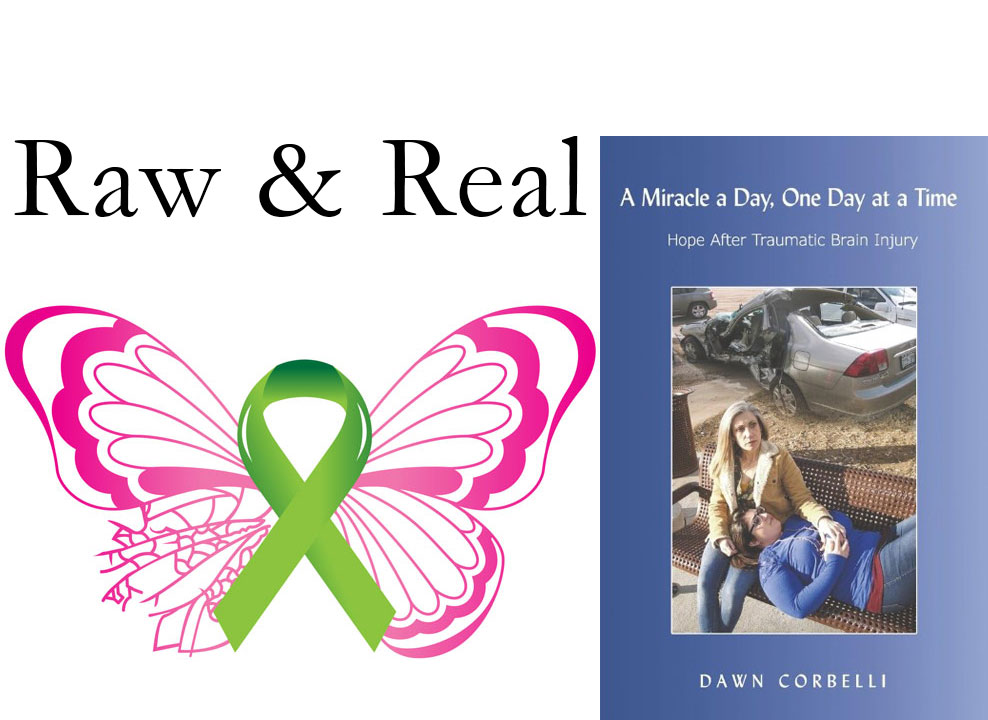
A Miracle a Day: One Day at a Time: Hope After Traumatic Brain Injury
Available many places where books are sold online. Here is one: Press the blue link https://store.bookbaby.com/book/a-miracle-a-day-one-day-at-a-time
There is always hope. Do not ever give up!
Thank you for taking the time to read my blog.
Have a beautiful week.

 Dawn Corbelli
Thank you for your post and the effort you put into it. I look forward to reading your posts.
LikeLike
Could I share the informati
LikeLike
Hi Kara. You are welcome to share any of my posts and information with anyone you like. It was nice of you to ask. Spread the word. I would like as many people as possible to become brain injury educated.
LikeLike
Thank you so much Craig. I appreciate your constant support. God bless you.
LikeLike
Thanks so much for sharing this. I now know why I also eat so fast and drink so fast, and other shared symptomology. Bless you all.
LikeLike
You are welcome Cathy. Thank you for taking time and interest to read my blog. I hope you will read more.
Dawn
LikeLike
Hi Cathy,
I am so glad I could help. And thank you for reading my blog. I appreciate your support.
LikeLike
Hi Cathy,
I am so glad I could help. And thank you for reading my blog. I appreciate your support. God bless you.
LikeLike