Have you ever wondered why neuropsychological testing is important? Did you know it is used on people for many reasons?
Neuropsychological assessment is a performance-based method to assess cognitive (thinking/mental) consequences of brain damage, brain disease, and severe mental illness. Resource: Clinical Applications of neuropsychological assessment https://www.ncbi.nih.gov>pmc
Neuropsychology joins the medical fields of:
-Neurology– the scientific study of nerves and their diseases. Resource: Oxford Languages Neurology
-Psychology-the scientific study of the mind and how it influences behavior. Resource: Oxford Languages Psychology
-Psychiatry-the study and treatment of mental illnesses. Resource: Oxford Languages Psychiatry.
With a neuropsychological assessment, mental functions tested include:
- General intellect.
- Reading/reading comprehension.
- Language usage and understanding of what others say.
- Attention/concentration.
- Processing speed.
- Learning and memory.
- Reasoning.
- Executive functions, which are higher skills you use to organize and plan, manage your time, problem solve, multi-task, make judgements, and maintain self-control.
- Visuospatial skills.
- Motor speed and dexterity.
- Mood and personality.
This testing is used to help with diagnosis, cognitive (thinking) strengths and weaknesses, to establish a baseline, and to help plan a treatment or other intervention. Resource: Neuropsychological Testing and Assessment my.clevelandclinic.org
I am 15 years post brain injury, and I just had my first neuropsychological assessment. It is not something you can study for. It can tell you where the majority of your strengths as well as your weaknesses and difficulties lie. My test lasted four hours, but they can last longer. Since I have never had one before, this will be used as a baseline for future exams to be compared to. It is good to have this assessment sometime when you have a brain injury. That way if you begin to notice differences in your thinking, you can take another test at least nine months to a year later after the first test and be able to see if and where the differences in your thinking are. The comparison of these assessments show your progress throughout time. I thought I did really well, and I did in some areas. I found out I am intelligent and very slow thinking. My processing speed shocked me. It turns out I scored in the lowest end for my processing speed compared to all others tested for my age group and education. I know I am slow to understand others and often need them to speak more slowly for me to be able to understand. My comprehension when reading is very slow, and I must read and reread many things before I can understand them. But at the lowest end?! I have to say it has taken me many years to realize I am not stupid, I am injured. This realization took many years to sink in and once it finally did, my self-confidence got better because I realized this is not my fault, not something I chose, and is not something I can control. I have to say, this shot me right back down to thinking I was stupid for a couple days. I never wanted to be in that place again, but there I was. At my follow up appointment my neuropsychologist told me that according to my MRI, my brain showed no damage, no scar tissue, no left-over blood from my injury, therefore I was 100% healed and it is as if I never had a brain injury at all. This goes against everything I understood about brain injuries. In my research I learned that once neurons in your brain are twisted, torn, or sheared from injury, they can rewire themselves so you can function, but never do go back the way they were and that’s what makes our personalities different than before. Which totally makes sense to me because I am not the me, I was before my mild-moderate traumatic brain injury. I have bipolar disorder as well as a traumatic brain injury. Mental illness can become worse after a brain injury. I went from the milder case of bipolar disorder 2, to the more severe bipolar disorder 1 with hallucinations after injury. This neuropsychologist also told me that all my cognitive weaknesses and difficulties were due to my mental illness. I sat there and cried because I thought I was one person for 15 years and now I have been given a completely different diagnosis. Here I am on brain injury support groups, and I published a book, and now I think I am a liar. It was devastating. She said I didn’t lie because I did go through all the things I wrote and write about, but she said somewhere along the line my symptoms from my brain injury went away and can now be attributed to mental illness, which after researching can cause brain damage, too.
I got home after getting my results and immediately contacted our previous neuropsychologist from the beginning of our brain injury journey 15 years ago. He is now retired but has over 30 years of experience with brain injured patients compared to the much less experienced doctor I saw for my testing. Dr. Nunley, who I trust with my life, did say no two neuropsychologists will agree with each other. There are believers that say brain injuries can completely disappear and nonbelievers that say brain injuries never completely go away. The difference between these two doctors is that Dr. Nunley has experienced having brain injuries, whereas this other doctor has not. Are you going to believe someone that has walked the same road you have? Or are you going to believe someone with no life experience in this area and just has textbook knowledge?
Dr. Nunley says I have repercussions of my brain injury to this day, and he has known me and my memory, or lack of, for 15 years. He knows my processing is slow and after being given so much information my mind just stops taking it in. I can only concentrate for a short time then I get lost. He also said part of my slow processing speed may be from my mental illness, and also likely from some of the medications I take for my bipolar disorder.
My confidence is back. I know 100% I am not stupid, and neither are any of you other brain injured people that often think that after having experienced so many deficits from a brain injury. Our brains have been injured. We did not choose this for ourselves, and we do the best we can with what we have been given. Look where you came from. Look how far you have come! Slow is still forward. The smallest wins add up to big ones. Being able to think, no matter how slowly, is a huge win!
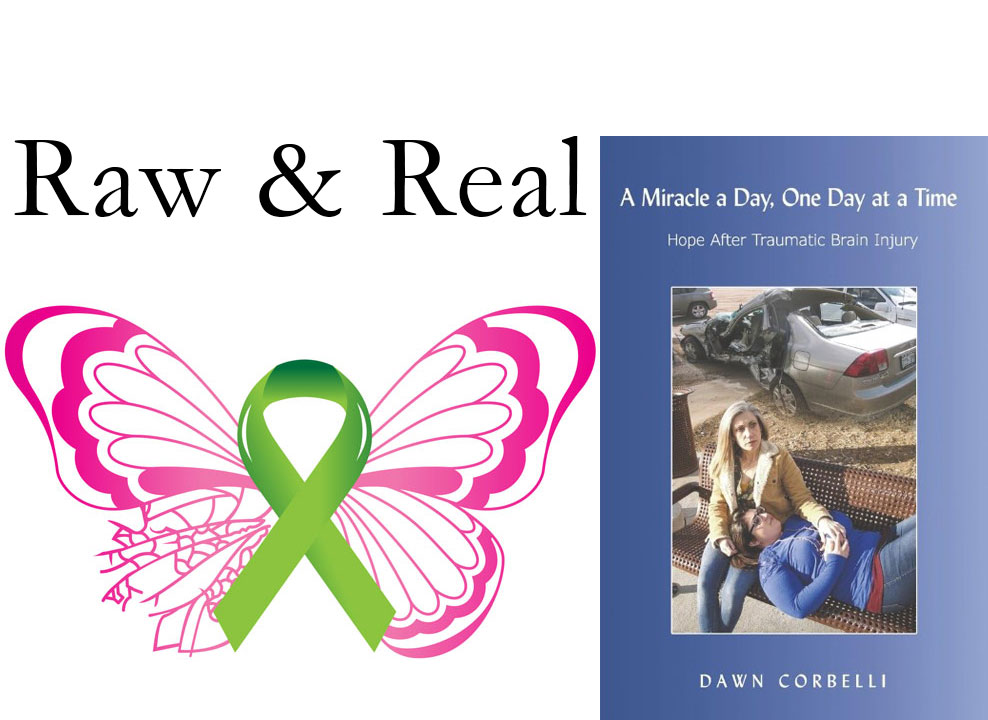
If you would like to be inspired and given hope for the future after brain injury, please read my book titled,
A Miracle a Day, One Day at a Time: Hope After traumatic Injury
It is about Veronica’s and my first 12 years of recovery after we both sustained brain injuries from the same car accident. I have also written about life from a caregiver’s point of view. It is very brain injury educational, and I wrote it so you will not feel alone in your experience on this often lonely road.
My book is available many places books are sold online. One place is
https://store.bookbaby.com/boo/a-miracle-a-day-one-day-at-a-time
Thank you for reading my blog.
Have a beautiful week.

 Dawn Corbelli
I remember my neuropsychological testing, I was waiting for some questions to address the fact that I did not feel like me, like I was a stranger in myself, but they never got into that. Also I think the neuropsych. that said to you your brain is healed from MRI results is flat out wrong, those brain scans only show so much about the brain, the problem is that they think the scans are more conclusive and informative than they are. I think the brain tissue can heal bleeding for example, but the person we are and problems we have remain. I have heard about many bad neuropsychologist. Yes, they really have to know brain injury to know how to help us.
LikeLiked by 1 person
Hi Daniel, Thank you for your comment. I agree with you about all the things you mentioned. I am not the me I was before my injury and there is no test to address that. I wish you all the best as you walk this difficult brain injury road. You are never alone.
LikeLike
Dr. Nunley is correct. And your post is terrific. This is great information. Great content!
LikeLike
Thank you Craig, for reading my blog. I very much appreciate your input. All the best to you.
LikeLike