I recently read a book called Giving Light to Darkness by Laura Kimbro. It is about her son that was diagnosed with a mild traumatic brain injury that committed suicide.
When Veronica and I teach high school students, we ask the students if any of them have been diagnosed with a concussion or mild traumatic brain injury. In our last class I asked if any of the students that raised their hands were told, “It is just a concussion. You will be fine.” Several of the students raise their hands. I always say, “There is nothing mild about it.” The biggest difference between mild, moderate, and severe brain injuries is how long someone is unconscious. This is not to say that some people aren’t severely injured even if they did not go unconscious or they were only unconscious for a few minutes. That can happen.
The symptoms of MILD concussion often go away by 3 months- post injury. When the symptoms continue longer than that, it is called Post Concussion Syndrome. For up to 30% of people having this, the symptoms can last for months, years, even a lifetime. Over 80% of Post Concussion Syndrome patients report personality changes, mental health problems such as depression, PTSD, irritability, and more. These symptoms are not to be taken lightly. (Resource: Giving Light to Darkness by Laura Kimbro)
We emphasize to the students that if they think about committing suicide, even as a fleeting thought, they should not keep it to themselves. They need to tell someone immediately. It can become life threatening.
One person dies by suicide every 40 seconds. The mean time from concussion to suicide is 5.7 years. (Resource: Giving Light to Darkness by Laura Kimbro)
You can always call 988 Lifeline, which is a 24-hour hotline (Resource: Help Yourself 988 Lifeline, https://988lifeline.org)
DBT-Dialectical Behavior Therapy for suicidal thoughts (for suicidal prevention) works well because it helps a person learn new techniques to regulate emotions and tolerate distress. (Resource: Oct 3, 2023, Top 5 Therapies to address Suicidal Thoughts-Alter Behavioral Health https://alterbehavioralhealth.com )
About two years post mild traumatic brain injury, Laura Kimbro’s son knew something wasn’t right in his mind. He told his mom, and she set up an appointment for him to talk to a professional about it. She couldn’t get the appointment for 26 days.
6 DAYS BEFORE THE APPOINTMENT, HE COMMITTED SUICIDE.
This story not only deeply touched my heart, but this book is also so full of vital information everyone needs to know, injured or not. One person sustains a brain injury every 9 seconds in the U.S. You never know when this is going to be you or someone else. This information may save someone’s life; it may even be your own.
Veronica and I usually talk about our story and brain injuries in the high school classes we teach. From now on this information will be included in every presentation. One student came up to us after class and told us her brain injury was considered MILD. Here we are 2 years later, and she is still having severe symptoms. She told us she had considered suicide, but as soon as she saw her psychiatrist he prescribed anti-depressants for her depression. This student told us that the anti-depressants saved her life, and she is now in talk therapy.
A CT scan and MRI do not show injury when it is a mild traumatic brain injury. Just because there’s no brain damage, that doesn’t mean there’s no brain injury …It is real and messes with your psyche. (Resource: Giving Light to Darkness by Laura Kimbro)
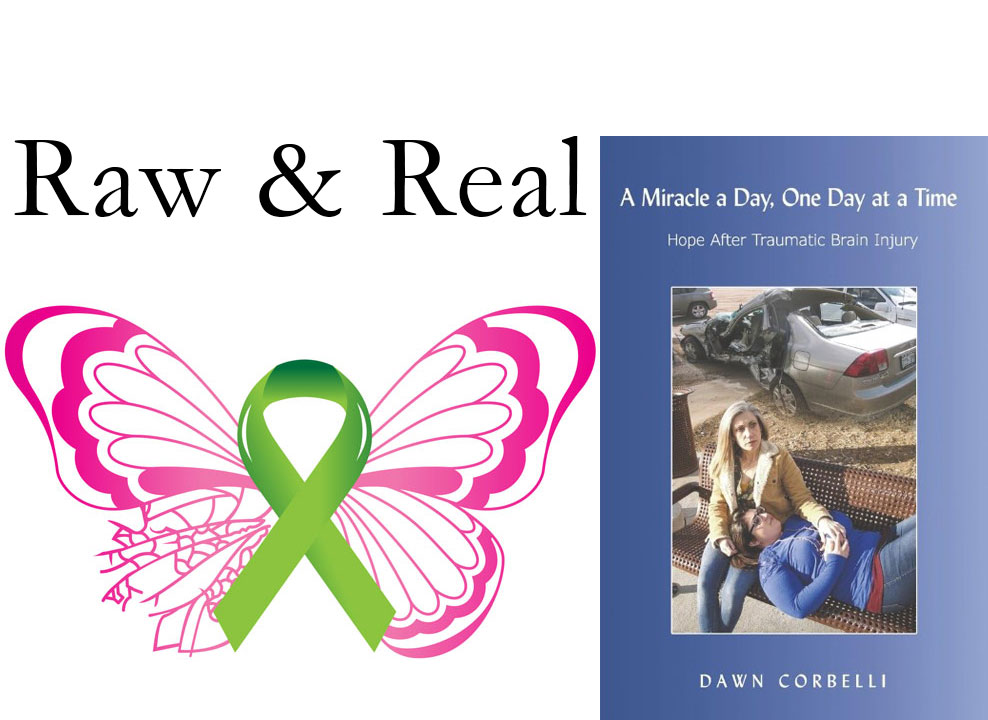
A Miracle a Day, One Day at a Time: Hope After Traumatic Brain Injury
Have a blessed week everyone.

 Dawn Corbelli