Veronica cries when she is happy, almost all the time, for weeks now. She cries so often, several times a day many days, but only for a moment. I am glad she is happy, but her emotional lability is so extreme. We can just expect her to cry when she says, “I love my family. I love my dogs. I have such a good life.” Anything that makes her feel love, makes her cry. We now know when to expect it, so I don’t know if this is part of her emotional lability, which refers to rapid, often exaggerated changes in mood, where strong emotions or feelings, (uncontrollable laughing or crying, or heightened irritability or temper), from her traumatic brain injury (tbi), or if it is truly Pseudobulbar Affect, or PBA. Resource: Understanding Mood Lability-Queensland Health https://www.health.qld.gov.au>…Actually, she cries when she feels good, bad, or anxious.
PBA criteria:
- Happens out of nowhere.
- Occurs for no good reason, or without any warning.
- Feels like an overreaction.
- Can’t stop the episode even though I want to.
- I don’t know why the episode is happening.
- For some, it is very embarrassing. Not for Veronica.
It is involuntary, sudden, frequent, exaggerated, and incongruent. 52% of people having a tbi are affected by PBA. Some patients who have a traumatic brain injury develop symptoms of uncontrollable crying and/or laughing very soon after their injury, for others these symptoms may not be recognized until months later, during the recovery process. Resource: About PBA Nudexta.com
Many years ago, Veronica would frequently burst into tears for no apparent reason. We thought she was depressed. Her psychiatrist had tried her on many different anti-depressants to no avail. Honestly, we saw a commercial on tv about Neudexta and mentioned it to our psychiatrist. That is when he first tried her on it. It was a last resort, and stopped her uncontrollable, inappropriate crying. But what we have been experiencing lately has been different. Her crying seems to become more or less severe at times, for months at a time. She is on the maximum dose of Neudexta.
It is important to know and understand that PBA is a neurologic condition, not a psychiatric condition. With PBA there is a disconnect between mood (how you feel), and expression (how you act).
Some patients experience only crying episodes, while others only laughing episodes, some people have both. People who witness these expressions of crying or laughing episodes may perceive them as being unreasonable and disconnected from the situation. Resource: About PBA neudexta.com We have become use to these reactions from Veronica. We know when she sees her sister, whom she loves dearly and gets so much joy in seeing, that she will cry as she hugs her hello, goodbye, and anytime during their visit.
In PBA, there is a disconnect between the frontal lobe (which controls emotions), and the cerebellum and brainstem (where reflexes are mediated). The effects are uncontrollable and can occur without an emotional trigger. Resource: Pseudobulbar Affect (PBA)-American Stroke Association https://www.stroke.org<aboutstroke
Synonyms for PBA include emotional lability, Pathological laughing and crying, involuntary emotional expression disorder, Compulsive laughing or weeping or, my favorite, Emotional Incontinence. Resource: Pseudobulbar Affect (PBA) clevelandclinic.org
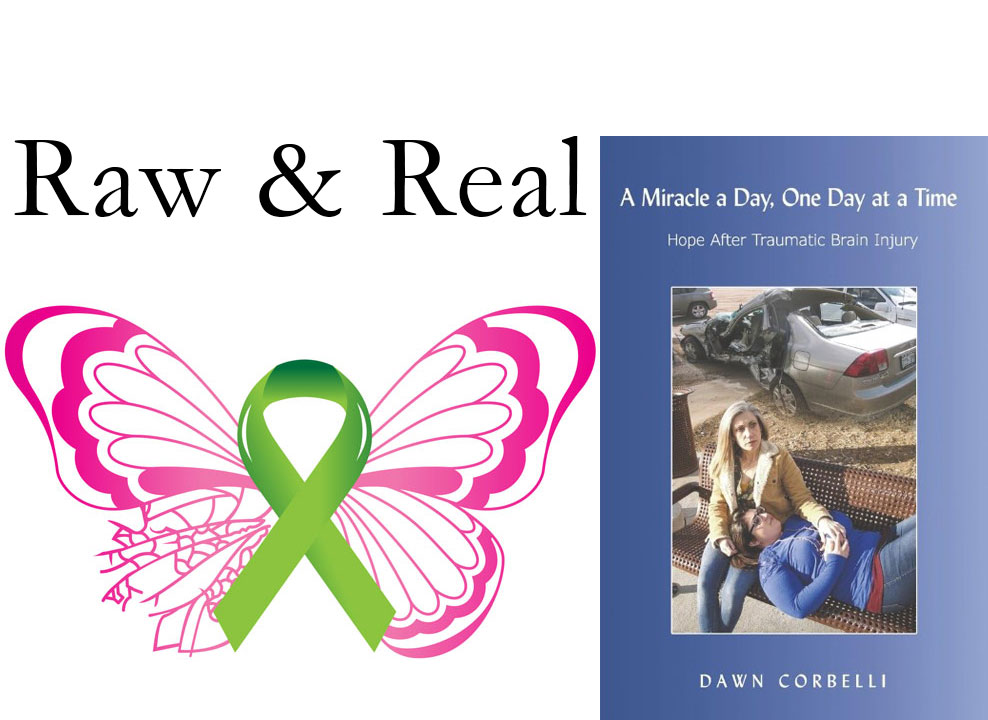
If you would like to learn more about our trials, triumphs, and other conditions Veronica has been diagnosed with since our injuries, please read my book titled,
A Miracle a Day, One Day at a Time: Hope After Traumatic Brain Injury
One of the many places it is available is:
https://store.bookbaby.com/book/a-miracle-a-day-one-day-at-a-time
This brain injury life is so confusing, and I have been living it for 16 years and still have so much left to learn. I will continue to keep researching and sharing what I learn with you.
Have a beautiful week and pay close attention to your wins. Even if they seem small to you, to someone, they are huge.

 Dawn Corbelli