The frontal lobe also controls executive function, which regulates brain activity for tasks like cognition, time management, attention span and focus, planning and organization, memory recall, inhibition control, multitasking, and interpretation of experience. When executive function is impaired, behavior becomes erratic. Lack of control affects patients’ ability to function in daily activities such as going to work or school, working independently, maintaining relationships, and other essential skills.[1]
Cognitive inhibition “refers to the mind’s ability to tune out stimuli that are irrelevant to the task/process at hand or to the mind’s current state.”[2] Inhibitory control is an executive function that “permits an individual to inhibit their impulses…in order to select a more appropriate behavior that is consistent with completing their goals.” Suppressing the urge to eat cake while on a diet is an example of inhibitory control.[3] Cognitive flexibility refers to the brain’s ability to transition from thinking about one concept to another.[4]
Five Months Out
Just a few short months post-hospital, I learned about the Pikes Peak Challenge, a hike for anyone, including the brain injured, to raise money for brain-injured patients. I decided I was going to participate. I began practicing by walking a neighborhood road that I used to jog on and was able to go to the end of the road and back, about a half mile one way. The road even sloped up a little. I was so proud of my accomplishment! My neighbor frequently reminded me that the challenge was a 13-mile hike and worried that it would be too much for me. I had a few months to train and didn’t want to listen to him.
At an appointment with my orthopedic doctor, I shared my goal with him. He told me in no uncertain terms that my pelvis was not yet healed and that I was no way ready to do even the light walking I was doing. I needed to stop immediately, take it easy, and no inclines whatsoever. I think because I was so focused on Veronica’s condition, it seemed to me that I felt healed and invincible compared to her. I was in denial that I was even hurt. This mindset lasted for at least three years.
I eventually learned that I suffered from a condition called anosognosia, a condition characterized by insufficient self-awareness in which patients are unaware of having a diagnosed disability.[5] That was me. Whenever I spoke of the accident, I said, “Veronica was in an accident,” never mentioning that I was in the car too. My family reminded me over and over, but more times than not, I refused to hear them. I have a brain injury, but when I looked at Veronica, her situation was so much worse than mine that I completely denied my injury altogether—and often still do.
16 or 5?
Life may seem easy until you live it with a brain injury. Controlling yourself, much less others, is especially difficult. Veronica was 16 but acted as if she were 5. Her behavior was so confusing for us as parents; she behaved like a 5-year-old in so many ways, and at the same time, she wanted to have sex with her boyfriend. Every time she came home from his house, she would tell me how many times they had sex, where, and in what position—every intimate detail. I tried to interrupt her, but she just kept going. Her brain-injured mind worked in peculiar, perverse ways—not always sexual—but with deliberate intent to behave in unreasonable or socially unacceptable ways, in spite of any consequences.[6]
Since Veronica was gaining weight quickly and growing out of her clothes just as quickly, we made regular trips to Plato’s Closet, a second-hand clothing store that stocks clothes that are one and a half years old or less. We only bought the cutest, trendiest outfits. Veronica loved dresses.
About six months after the accident, we went to look at the lot where we were having a new house built. Veronica stood next to our car, paying no attention to any of the other houses. She pulled her skirt up over her waist, readjusted her thong, then pulled down her shirt, and finally pulled down her dress, as if no one could see her. The whole time, Greg and I were yelling, “Veronica! What are you doing?! Pull down your dress!” She said in her husky voice, “I’m fixing my shirt,” and later told us, she thought no one could see when she stood behind the car. All we could do was laugh because the only thing we could do was keep telling her she couldn’t do things like that. And keep her out of dresses for a while.
At the same time, I was trying to cope with my own brain injury. While at a friend’s house, I encouraged our friend’s son to drink alcohol despite the fact that he was underage and going into the Army the next day. I kept saying, “If he’s old enough to serve, he’s old enough to drink.” I went so far as to drive home to pick up a bottle of Petron for him, knowing he liked it. His mother kept saying no, but I couldn’t grasp the idea that not only was he underage, but he also had to get up early the next day to go to boot camp. I wasn’t thinking straight and was certainly not thinking or behaving like a good friend. Much later, I apologized for my behavior.
One day Veronica went with Kylie to a tattoo shop and came home with her nipples pierced, without our permission. Even when we or Kylie told her no, she had a way of doing and getting what she wanted with other people. She waited until Kylie was getting a tattoo and then asked about piercing. She was 18 at the time, of legal age to get pierced, so the piercer had no reason to refuse her request. In this case, her behavior wasn’t a function of her brain injury; Veronica can simply be wild occasionally. But some of her behavior was a direct result of the injury.
Soon afterward, we went to a party at a friend’s house and had some drinks despite warnings against drinking alcohol with a brain injury. We did not realize what the consequences would be if Veronica and I had a few drinks. Now, we know that alcohol affects people with brain injuries faster than others, suppressing their ability to think clearly. Veronica was standing in a group of people including a friend her age and his father. She lifted up her shirt to show them her breasts and nipple rings. As bad as that was, I was even worse. Greg couldn’t babysit me every minute, and I had more than just a few drinks. Inside, outside, in the backyard, in the front yard—no matter where I went, alcohol was available, and I found it everywhere. I ended up sitting in a chair in the garage, drink in hand, head bobbing up and down, eyes half closed, yelling, “Greg! I want to suck your dick!” Not once, but repeatedly. People stared at me. I just kept saying, “It’s OK. He’s my husband.” Between being both drunk and brain injured, I was certainly not thinking straight. We were never invited back to a party at their house—big surprise. Friends come and go throughout our lives. During this period in our lives, they mostly went. It became a lonely time for both Veronica and me.
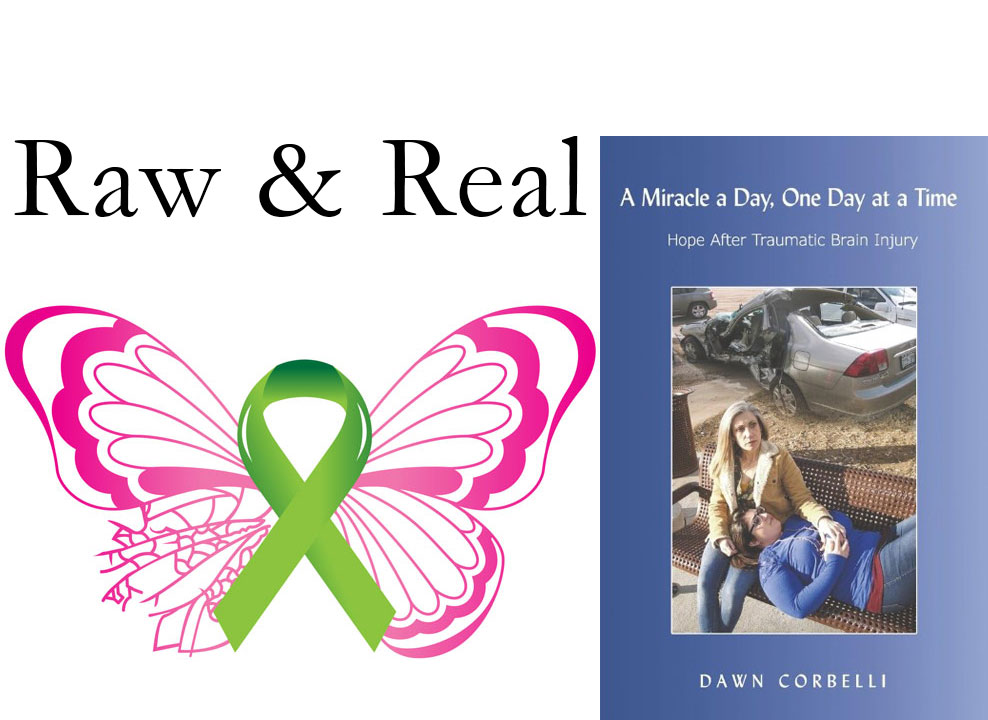
If you would be interested in reading more than a blurb of my book titled,
A Miracle a Day, One Day at a Time: hope after Traumatic Brain Injury
you can purchase it at Amazon, right here from my website. Go to Menu, press Book, scroll down and it is available in paperback and on kindle.
If you do read my book, please take a moment to leave a review. I would highly appreciate it.
There are many brain injury support groups on Facebook and I very highly recommend being a part of one or more. You will be able to converse with others that understand you and offer kindness, compassion, empathy, and education. Please remember that although this brain injury journey can be lonely, you are by far not alone in your experience.
Have a wonderful week everyone!
[1] “Executive Function and Executive Function Disorder.” WebMD, www.webmd.com/add-adhd/executive-function. Assessed 4 Sept. 2020.
[2] “Cognitive Inhibition.” Wikipedia, en.wikipedia.org/wiki/Cognitive_inhibition. Assessed 4 Sept. 2020.
[3] “Inhibitory Control.” Wikipedia, en.wikipedia.org/wiki/Inhibitory_control. Assessed 4 Sept. 2020.
[4] “What is Cognitive Flexibility?” Mental Health Daily, 26 July 2015, mentalhealthdaily.com/2015/07/24/what-is-cognitive-flexibility/.
[5] “Anosognosia.” Wikipedia, en.wikipedia.org/wiki/Anosognosia. Accessed 4 Sept. 2020.
[6] “Perverse: Definition of Perverse.” Lexico Dictionaries, www.lexico.com/definition/perverse. Accessed 11 Jan. 2021.

 Dawn Corbelli